
Dutch wholesale electricity prices rose 12.5% in 2025. But if you know when to charge, you can pay less than last year - or even get paid to plug in. Here’s what the data tells us.
1. Prices rose 12% - but not when you’d expect
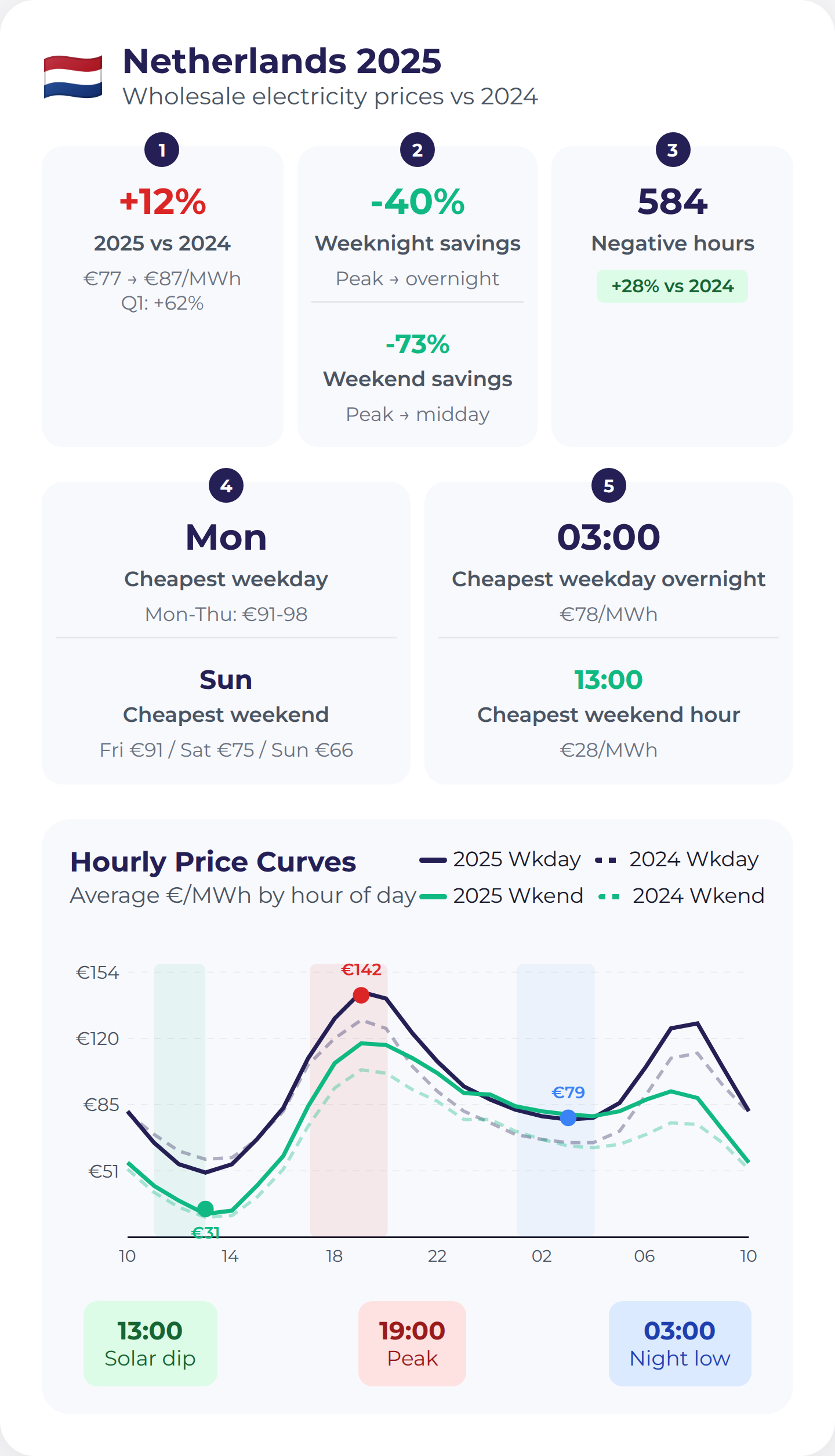
The average wholesale price jumped from €77 to €87/MWh. Sounds bad. But here’s the twist: almost all of that increase came from one brutal winter.
January and February 2025 were extreme. February hit €126/MWh - nearly double the same month in 2024. Cold weather drained gas storage across Europe, and high-pressure systems meant less wind power.
But from May onwards? Prices were actually flat or lower than 2024. November 2025 was 17% cheaper than November 2024.
The takeaway: If you’re on a dynamic tariff, your winter bills hurt. But summer and autumn gave some of it back.
2. The solar duck curve keeps getting deeper
You’ve probably heard it before: charge your EV during the day when solar is abundant. In the Netherlands, midday has been cheaper than midnight on summer weekends since at least 2024.
But here’s what’s changed: the gap keeps widening.
In summer 2025, weekend midday prices (12:00-14:00) averaged -€17/MWh - yes, negative. Meanwhile, midnight (00:00-03:00) averaged €89/MWh. That’s a €106 difference.
The problem? Most EVs are either plugged in immediately when you get home (around 19:00, the most expensive hour at €144/MWh), or scheduled to start at midnight (€88/MWh). Both miss the real opportunity.
On weekdays, charging at 03:00 instead of 19:00 saves you 40%. On summer weekends, charging at 13:00 instead of 19:00 saves you 73% - and you might actually get paid.
Dutch energy companies are increasingly penalising solar feed-in to the grid. This creates even more incentive for real-time solar charging - using your own panels to charge your car when the sun is shining, rather than exporting power at a loss.
Gridio supports this with automatic real-time charging based on live data from inverters and P1 dongles connected through the app. Your car charges when your panels are producing, no manual scheduling needed.
The takeaway: The solar duck curve isn’t news, but the opportunity keeps growing. Midday charging - especially on weekends - is now significantly cheaper than overnight.
3. 584 hours of free electricity
In 2025, wholesale prices went negative for 584 hours - up 28% from 2024. That’s the highest in Europe.
Most of these happened between March and June, during sunny weekend afternoons. May alone had 145 negative hours - nearly 20% of the entire month.
If you’re on a dynamic tariff that passes through wholesale prices, these hours mean you literally get paid to charge your car.
The takeaway: Dynamic tariffs aren’t just about avoiding peaks anymore. They’re about catching the growing number of hours when electricity is free or better.
4. Sunday is your secret weapon
Not all days are equal. Wholesale prices follow non-domestic energy use - offices, factories, commercial buildings - and that demand drops on weekends.
Sunday is consistently the cheapest day of the week. In 2025, Sunday averaged €66/MWh compared to €98/MWh on Wednesday. That’s 33% cheaper.
Saturday is also good, averaging €75/MWh. Friday sits at €91/MWh - similar to weekdays.
Among weekdays, Wednesday is the most expensive - the midweek peak of commercial activity. Monday is the cheapest weekday at €91/MWh.
The takeaway: If you can shift your main charging to Sunday, you’ll save significantly. If that’s not possible, Friday evening into Saturday is your next best window.
5. The best times to charge your EV
Let’s make it practical. Based on 2025 data, here’s when to charge:
Weekdays (plugged in overnight):
In winter (November-February), prices are lowest around 03:00 at €78/MWh. If you can schedule your car to start then instead of midnight, you’ll save an extra 11%.
Summer is different. Prices actually dip when you first get home - 17:00 is often the cheapest evening hour at around €67/MWh. But then they spike: 19:00 hits €120/MWh and 20:00 peaks at €151/MWh.
The optimal summer weekday strategy: charge immediately when you get home (17:00-18:00), pause during the evening peak (19:00-22:00), then resume at 03:00 if you need more range.
Gridio handles this automatically by splitting your charging into multiple sessions when needed.
Weekends (flexible all day):
Charge at 13:00 for the best rates - often free or negative. Even morning is decent at €27/MWh. Just avoid evening when prices climb back toward €100/MWh.
The hour to avoid at all costs: 19:00-21:00 on weekdays. This is peak demand, peak price - averaging €140/MWh. Charging during dinner time is the most expensive choice you can make.
The takeaway: Avoid the evening peak, catch midday on summer weekends, and let your charging split across the cheapest windows.
The bottom line
2025 was a year of extremes. A brutal winter pushed average prices up, but solar growth created more free electricity hours than ever before.
The gap between the cheapest and most expensive hours widened to €92/MWh - which means the savings from smart charging are bigger than ever. The average Gridio user in the Netherlands has reduced their home charging costs by 25% simply by letting the app optimise when their car charges.
If you’re still charging on a flat tariff or plugging in whenever it’s convenient, you’re leaving money on the table. A dynamic tariff plus smart timing is the simplest upgrade you can make.
Charge smart. Charge cheap. Let the grid pay you when the sun is shining.

