
Lithuanian wholesale electricity prices held steady in 2025 - essentially flat compared to 2024. But the gap between cheap and expensive hours means smart charging can still save you nearly 60%. Here’s what the data tells us.
1. Prices stayed flat - stability in uncertain times
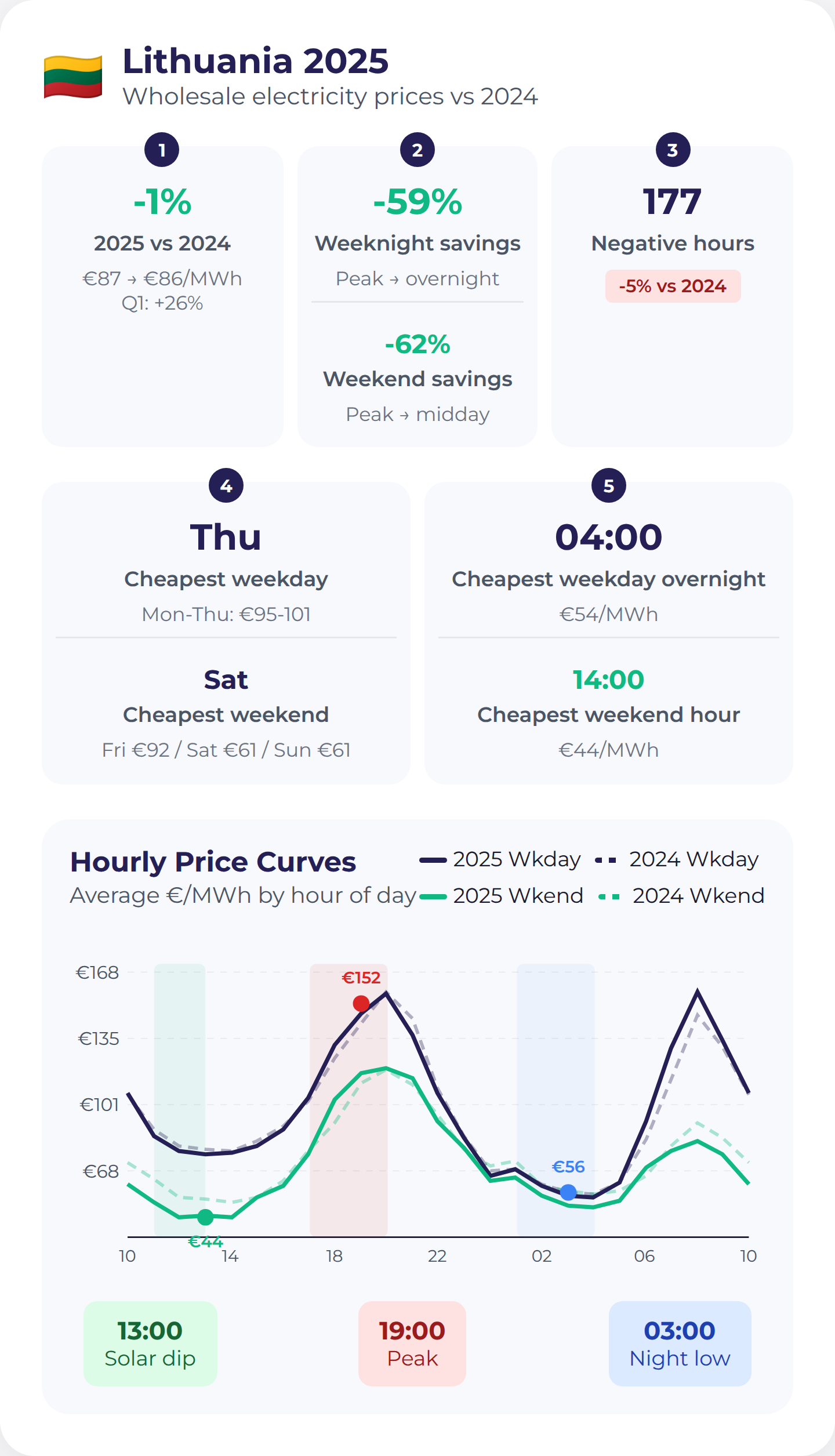
While neighbouring markets swung up or down, Lithuania’s average wholesale price barely moved - from €87 to €86/MWh, a drop of just 1%.
This stability comes from Lithuania’s interconnected position in the Baltic grid, with links to Poland, Sweden, and its Baltic neighbours spreading out price volatility.
Q1 2025 saw the usual winter pressure (+23% vs Q1 2024), but the rest of the year balanced it out with lower prices, especially in the summer months.
The takeaway: If you’re on a dynamic tariff, your bills probably looked similar to last year - unless you were smart about timing.
2. Peak vs off-peak: 60% savings available
The stability in average prices masks a big opportunity. The gap between expensive and cheap hours is substantial.
Charging at 04:00 instead of the evening peak saves you 59%. On weekends, shifting to midday saves you 62%.
Most EV drivers plug in when they get home (around 19:00) or schedule charging for midnight. Both approaches leave money on the table. The real sweet spots are later at night and during weekend afternoons.
Gridio handles this automatically by shifting your charging to the cheapest windows - capturing 04:00 lows on weeknights and midday dips on weekends.
The takeaway: Average prices may be flat, but smart timing still delivers major savings.
3. 177 hours of negative prices
In 2025, wholesale prices went negative for 177 hours - down slightly from 2024 (-5%). These are moments when the grid has more electricity than it needs, and prices flip below zero.
Most negative hours occur during sunny weekend afternoons when European solar generation floods the interconnected grid. If you’re on a dynamic tariff that passes through wholesale prices, these hours mean you get paid to charge.
The takeaway: Dynamic tariffs unlock access to free electricity. 177 hours isn’t as many as Western Europe, but it’s still significant.
4. Thursday and Saturday are your best days
Not all days are equal. Wholesale prices follow non-domestic energy use - offices, factories, commercial buildings - and that demand varies through the week.
Thursday is the cheapest weekday in Lithuania, as the week’s peak activity starts winding down. Monday and Tuesday tend to be more expensive as businesses ramp up.
Saturday is the cheapest weekend day, edging out Sunday. Both weekend days are significantly cheaper than weekdays overall.
The takeaway: If you can shift your main charging to Saturday, you’ll save noticeably. Thursday is your best option for weekday charging.
5. The best times to charge your EV
Let’s make it practical. Based on 2025 data, here’s when to charge:
Weekdays (plugged in overnight):
Prices are lowest around 04:00 at €73/MWh. Schedule your car to start then rather than midnight for extra savings. The evening peak (19:00-21:00) averages nearly €180/MWh - avoid it completely.
Weekends (flexible all day):
Charge at 14:00 for the best rates - around €52/MWh. The afternoon solar dip affects Lithuania too, even though it’s less dramatic than in sunnier markets.
The hour to avoid at all costs: 19:00-21:00 on weekdays. This is when everyone comes home, turns on lights, and - if they’re not careful - plugs in their EV at the worst possible moment.
The takeaway: The rules are simple: skip the evening peak, target 04:00 overnight, and use weekend afternoons when possible.
The bottom line
2025 was a stable year for Lithuanian electricity prices. No dramatic swings, but also no free ride - the gap between smart and dumb charging remains nearly 60%.
If you’re still charging whenever it’s convenient, you’re paying more than you need to. A dynamic tariff plus basic timing awareness is the simplest upgrade you can make.
Charge smart. Charge cheap.

