
Swedish wholesale electricity prices in the SE3 zone (Stockholm) rose 31% in 2025 - the biggest jump in our European analysis. But Sweden still has some of the cheapest electricity on the continent, and smart charging can save you over 50%. Here’s what the data tells us.
1. Prices rose 31% - but context matters
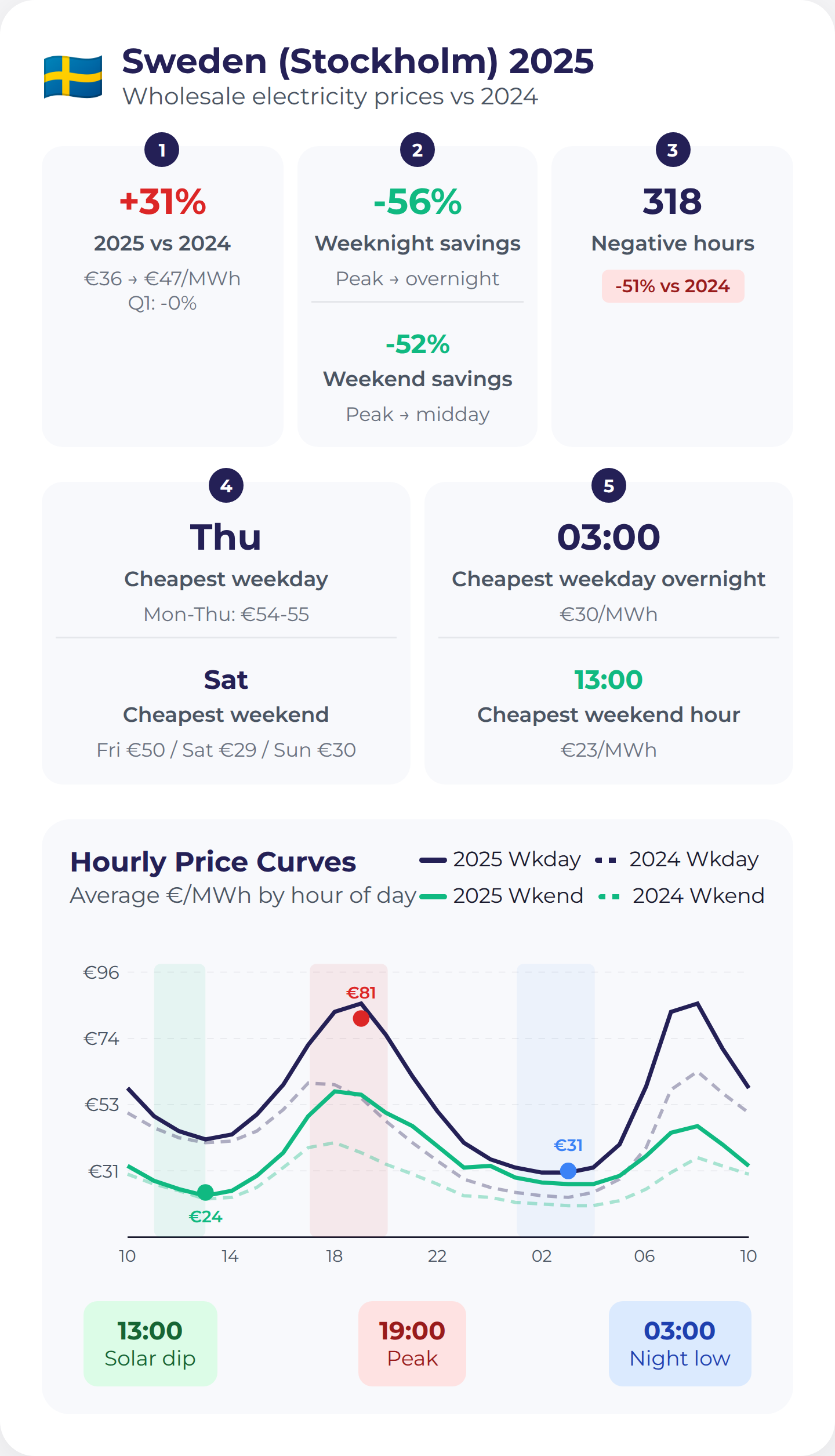
The SE3 zone saw average prices jump from €36 to €47/MWh. That’s a significant increase in percentage terms, but look at the absolute numbers: €47/MWh is still cheaper than almost every other European market.
For comparison, the Netherlands averaged €87/MWh and Belgium €83/MWh. Swedish EV drivers are still paying roughly half what Western Europeans pay.
The increase came from tighter hydro conditions - Sweden’s reservoirs didn’t fill as well as in previous years, reducing the surplus that usually keeps prices low. Q1 2025 saw the biggest pressure (+51% vs Q1 2024).
The takeaway: Prices rose meaningfully, but Swedish electricity remains among Europe’s cheapest. Smart charging still makes sense.
2. 56% weeknight savings, 52% weekend savings
The gap between peak and off-peak hours remains substantial despite the overall price increase.
Charging at 03:00 instead of the evening peak saves you 56%. On weekends, shifting to midday saves you 52%.
Sweden’s savings are more balanced between overnight and weekend daytime compared to other markets. Both options deliver similar results, giving you flexibility.
Gridio optimises automatically across both windows, shifting your charging to whichever is cheapest on any given day.
The takeaway: Whether you prefer overnight or daytime charging, Sweden offers strong savings either way.
3. Negative hours dropped 51% - the biggest decline
In 2025, wholesale prices went negative for 318 hours - down 51% from 2024’s 651 hours. This is the biggest decline in negative hours of any market we analysed.
The drop reflects tighter supply conditions. When hydro reservoirs are lower, there’s less surplus generation to push prices negative. Sweden’s famous cheap electricity depends heavily on water levels.
Negative hours still occur, primarily during windy periods and sunny days when generation exceeds demand. But they’re less frequent than before.
The takeaway: Don’t count on negative prices as much as in previous years. Focus on the consistent overnight and midday savings instead.
4. Thursday and Saturday are your best days
Not all days are equal. Wholesale prices follow non-domestic energy use - offices, factories, commercial buildings - and that demand varies through the week.
Thursday is the cheapest weekday in Sweden’s SE3 zone, as the week’s activity starts to wind down toward the weekend. Wednesday tends to be the most expensive.
Saturday is the cheapest weekend day, beating Sunday by a small margin. Both weekend days are noticeably cheaper than weekdays.
The takeaway: If you can concentrate charging on Saturday, you’ll get the best rates. Thursday is optimal for weekday charging.
5. The best times to charge your EV
Let’s make it practical. Based on 2025 data, here’s when to charge:
Weekdays (plugged in overnight):
Prices are lowest around 03:00 at €37/MWh - still remarkably cheap by European standards. The evening peak (19:00-21:00) averages around €85/MWh, so avoiding it saves over 50%.
Weekends (flexible all day):
Charge at 13:00 for the best rates - around €24/MWh. Weekend midday in Sweden is genuinely cheap, benefiting from both lower demand and any solar/wind surplus.
The hour to avoid at all costs: 19:00-21:00 on weekdays. Even in cheap Sweden, the evening peak is more than double the overnight low. There’s no reason to pay extra.
The takeaway: Swedish charging is cheap overall, but timing still matters. Target 03:00 overnight and 13:00 on weekends to maximise savings.
The bottom line
2025 saw Swedish prices rise more than anywhere else in our analysis - but €47/MWh remains a bargain compared to Western Europe. The fundamentals of smart charging still apply: avoid the evening peak, target overnight or midday lows, and save over 50%.
Negative price hours are less frequent than before, so don’t rely on free electricity. Focus on consistent timing instead.
A dynamic tariff plus smart timing is the simplest upgrade you can make.
Charge smart. Charge cheap.

