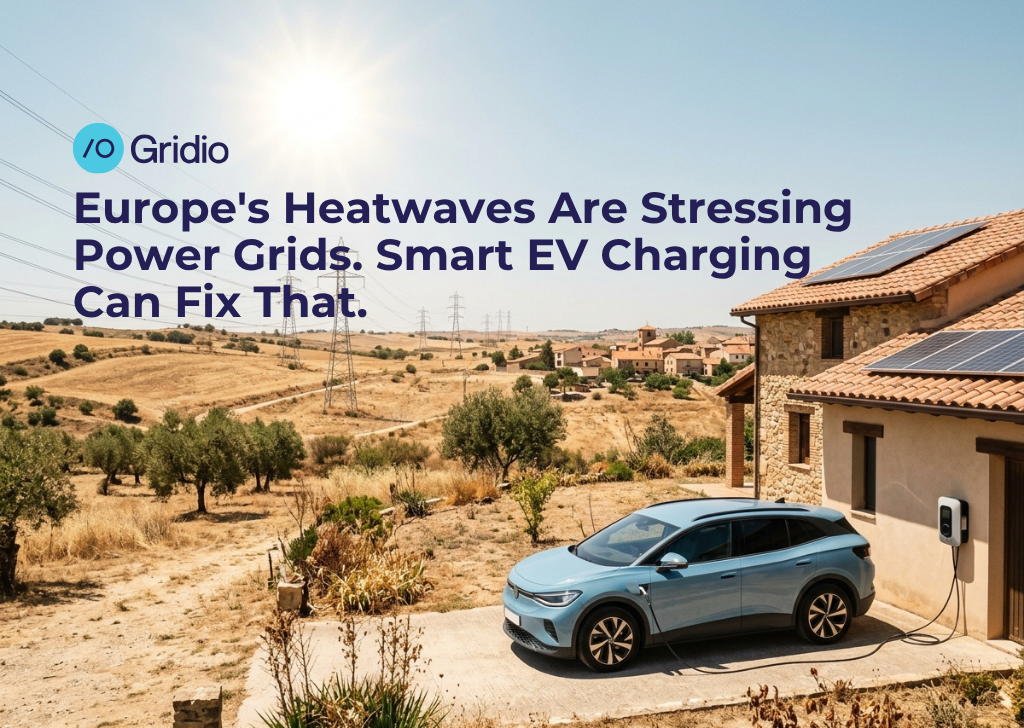
Europe's power grids are already under pressure and it is only early June.
Europe's first major heatwave of 2026 arrived weeks ahead of schedule. A heat dome parked over Western and Central Europe in late May, running temperatures 12–16°C above seasonal norms. France recorded its hottest national average May temperature on record (24.9°C on 26 May), with Angoulême reaching 37.8°C on 28 May. Portugal hit 40.3°C on 27 May – a new national May record, with 22 weather stations setting all-time highs the same day. The Netherlands broke its record for 26 May with 30.4°C in De Bilt. Belgium hit 31°C in Brussels. Luxembourg set a new May record at 33.6°C. Spain approached 38°C inland.
Late May 2026 – national records shattered across Western Europe
🇵🇹
Portugal
40.3°C
National May record
Mora, 27 May – 22 stations set all-time highs the same day
🇫🇷
France
37.8°C
Hottest May on record
Angoulême, 28 May – national avg 24.9°C on 26 May, highest ever
🇪🇸
Spain
~38°C
Well above seasonal norm
Inland regions – weeks ahead of typical peak summer heat
🇩🇪
Germany
30–33°C
12–16°C above norm
Across southern and central regions, 25–27 May 2026
🇱🇺
Luxembourg
33.6°C
National May record
Reckange, 27 May 2026
🇧🇪
Belgium
31°C
Daily record broken
Brussels, 25–26 May – Uccle broke its 1985 record on 26 May
🇳🇱
Netherlands
30.4°C
May station record
De Bilt, 26 May – previous record was 29.1°C set in 2005
🇭🇺
Hungary
32.2°C
Budapest record high
HungaroMet confirmed new station record, 25 May 2026
🇩🇰
Denmark
28°C+
Significantly above norm
Late May heat extending into Scandinavia and the Baltic region
And the grids felt it immediately. In France, hourly prices on the Epex Spot exchange turned negative around 1 p.m. on 26 May as solar flooded the grid. In Germany, solar generation had already reached 50 GW on the hottest days of the 2025 heatwave – covering up to 39% of national demand. By evening in both cases, the picture reversed sharply.
This is not an isolated event. It is the new pattern.
As heatwaves spread across Western Europe, electricity demand for cooling surges, while solar production floods grids with cheap midday energy. The result is a new energy paradox: extremely low prices during the day, followed by sharp evening peaks when millions return home, turn on air conditioning, and plug in EVs at the same time.
This is exactly where smart charging becomes critical.
2026 heatwave – May records broken across Western Europe
40.3°C
Portugal's hottest May day on record, Mora, 27 May 2026 – 22 stations set new all-time highs
37.8°C
France, Angoulême, 28 May 2026 – national average 24.9°C that day, hottest May on record
50 GW
Solar output peak in Germany during the July 2025 heatwave – up to 39% of national demand in a single day
1,223
Negative-price hours across EU day-ahead markets in Q1 2026 – more than double Q1 2025
397 hrs
Spain's negative electricity price hours in Q1 2026 alone – vs. 48 hours in Q1 2025
+175%
Average daily electricity price rise in Germany during the July 2025 heatwave peak week
Why Heatwaves Are Becoming an Energy Problem
Europe’s electricity system was not designed for prolonged heatwaves combined with mass electrification.
During extreme temperatures:
- Air conditioning demand spikes sharply
- Grid congestion increases
- Electricity prices become more volatile
- Peak demand shifts later into the evening
At the same time, solar generation reaches record levels during the day.
This creates a strange imbalance:
- Too much electricity at noon
- Not enough flexibility in the evening
And that flexibility problem is growing fast.
Midday Solar Surplus Is Growing Across Europe
In countries like the Netherlands, Belgium, Germany, France, Spain and Denmark, solar generation during sunny summer days can push electricity prices to zero or below.
This is no longer a rare anomaly and the chart below shows just how fast this is accelerating.
Negative electricity price hours are accelerating – Q1 2026 vs Q1 2025
Hours of negative day-ahead prices, Q1 2026
vs Q1 2025 – Spain had only 73 hrs | Greece had 0 hrs
1,223
Total negative-price hours across all EU day-ahead markets in Q1 2026 – more than double Q1 2025 (593 hrs) and over 10× the Q1 2022 low of 119 hrs
16%
Share of all Q1 trading hours that cleared below zero in Spain – before 2023, Spain had never recorded a single negative-price hour in Q1
50 GW
Solar output peak in Germany during the July 2025 heatwave – generating up to 39% of national electricity demand in a single day
During the May 2026 heatwave, French prices on the Epex Spot exchange turned negative at 1 p.m. on 26 May as solar supply outpaced demand by a wide margin. In Germany, solar output reached 50 GW at peak during the July 2025 heatwave – generating up to 39% of national electricity demand in a single day. In Belgium and the Netherlands, unusually sunny conditions in 2025 alone boosted solar output by 26% and 21% respectively compared to prior years.
Without flexible demand to absorb this surplus, a growing share of renewable energy risks being curtailed or simply wasted.
The Evening Peak Problem
The challenge begins when the sun starts to disappear.
Around the same time:
- people return home
- cooling demand remains high
- cooking demand increases
- EVs begin charging simultaneously
This creates sharp evening peaks that stress local grids and push prices upward.
In 2026, with 15-minute pricing now active in many European markets, these swings are sharper than ever. During the July 2025 heatwave, evening prices spiked above €470/MWh in Poland and €400/MWh in Germany. Average daily prices rose 175% in Germany and 108% in France during that same week – while midday solar was, at times, effectively free.
☀️
Midday
Solar surplus, prices collapse
- Solar generation peaks across NL, BE, DE, DK, FR, ES
- Electricity prices near zero or negative
- Renewable energy risks being curtailed
- Grids need flexible demand to absorb the surplus
- June 2025: highest EU solar generation on record (+22%)
🌙
Evening
AC demand spikes, prices surge
- People return home, air conditioning stays on
- Cooking, heating and EV charging all surge at once
- Grid stress peaks, prices can spike above €400/MWh
- 15-minute spot pricing makes swings even sharper
- Demand up 14% on peak heatwave days (Ember, 2025)
☀️
Solar surplus
Cheap midday energy floods the grid – prices collapse
🚗
Smart EV charging
Gridio automatically shifts charging to cheap solar hours
🌐
Grid flexibility
Evening peak softens – renewables don't go to waste
EVs are the biggest flexible battery in Europe – already parked in the driveway. Smart charging turns them into a grid stability asset, automatically.
EVs Can Either Stress the Grid or Stabilise It
Electric vehicles are often discussed as a future grid challenge. But the reality depends entirely on when they charge.
⚡
Without smart charging – EVs stress the grid
Drivers plug in immediately after arriving home – right when evening demand peaks
Charging adds to AC, cooking and heating load all hitting at the same time
Grid stress increases, prices spike – sometimes above €400/MWh
Cheap midday solar goes unused while drivers pay peak rates in the evening
🚗
With smart charging – EVs stabilise the grid
Charging shifts to midday when solar is abundant and prices are lowest
Evening demand peaks are softened – less grid stress, lower prices for everyone
Renewable energy is absorbed instead of curtailed – solar surplus finds a home
Most cars are parked 8–10 hours a day – flexibility is already there, just waiting to be used
The biggest flexible battery in Europe is already parked in the driveway.
Gridio activates it automatically – no action needed from the driver.
Why Smart Charging Matters More Than Ever
This flexibility only works if charging becomes intelligent.
⏱
Manual charging can't keep up
Intraday prices now swing by hundreds of euros per MWh within hours
Renewable production varies with clouds, wind and temperature – impossible to predict manually
Heatwave demand spikes hit suddenly – a fixed charging schedule set the night before is already outdated
🧠
Gridio optimises automatically
Reads live electricity prices and adjusts charging in real time
Tracks renewable availability – shifts load toward solar-heavy windows
Respects driver preferences – car is always ready when needed, at the lowest possible cost
Charges when energy is cheapest
Midday solar windows, off-peak hours
Charges when solar is highest
Absorbs surplus before it's wasted
Charges when the grid is least stressed
Avoids evening peaks automatically
And all of it happens automatically without the driver doing a thing.
The Energy Transition Needs Flexible EV Charging
Europe is rapidly adding solar generation, electric vehicles, electrified heating, and battery storage. But infrastructure expansion alone is not enough.
The IEA projects EU electricity demand to grow around 2.3% per year through 2030, with solar set to reach 20% of EU generation by 2030. More than 400 GW of renewable capacity is expected to be added between 2026 and 2030, with 70% coming from solar alone. A 2026 Solar Power Europe report meanwhile warns that more than 120 GW of anticipated renewable capacity is at risk due to insufficient grid infrastructure – including 16 GW of rooftop solar affecting over 1.5 million households.
The next phase of the energy transition will depend heavily on software orchestration: coordinating flexible demand, balancing renewable variability, and optimising energy flows in real time.
Smart EV charging is one of the fastest scalable flexibility solutions available today.
Simple Ways EV Drivers Can Reduce Summer Charging Costs
Don't charge when you arrive home
Evening prices spike when everyone gets home at the same time. Delaying by even 2–3 hours can make a significant difference.
Avoids peak pricing
Use smart charging instead of a fixed timer
Fixed timers can't react to real-time price swings. Smart charging adjusts automatically — always finding the cheapest window.
Adapts to live prices
Shift charging toward solar-heavy midday hours
On sunny summer days, midday electricity is often the cheapest of the week — sometimes free or below zero in some markets.
Lowest prices of the day
Reduce reliance on public fast chargers
Fast chargers are convenient but expensive, especially during heatwaves when demand is high. Home smart charging is almost always cheaper.
Saves on per-kWh cost
Use solar or renewable charging mode
If you have solar panels or access to a solar charging mode, summer heatwaves are exactly when this produces the most value.
Clean and cheapest
Charge to 80%, not 100% in hot weather
Heat accelerates battery degradation at high charge levels. Keeping the limit at 80% protects long-term battery health with no impact on daily range.
Protects battery health
Small timing changes add up to major savings over a summer.
Gridio handles all of this automatically – for 10+ car brands, no extra hardware needed.
The Bottom Line
Europe's heatwaves are exposing a new energy reality: solar abundance during the day, expensive evening peaks, and growing pressure on grids that were never designed for this combination. Electric vehicles can either amplify this problem or help solve it. The difference comes down to one thing: when they charge.
For EV drivers
Let your car charge smarter this summer
Gridio automatically shifts your charging to the cheapest, greenest hours of the day – no action needed from you. Works with 10+ car brands directly via OEM API, no extra hardware required.
📲 Download Gridio
For energy companies, utilities and DSOs
Scale EV flexibility across your grid
Heatwaves are stress-testing grid flexibility across every European market. If you are exploring how smart EV charging can support demand response, peak shaving or renewable integration at scale – we would like to talk.
✉ Get in touch