
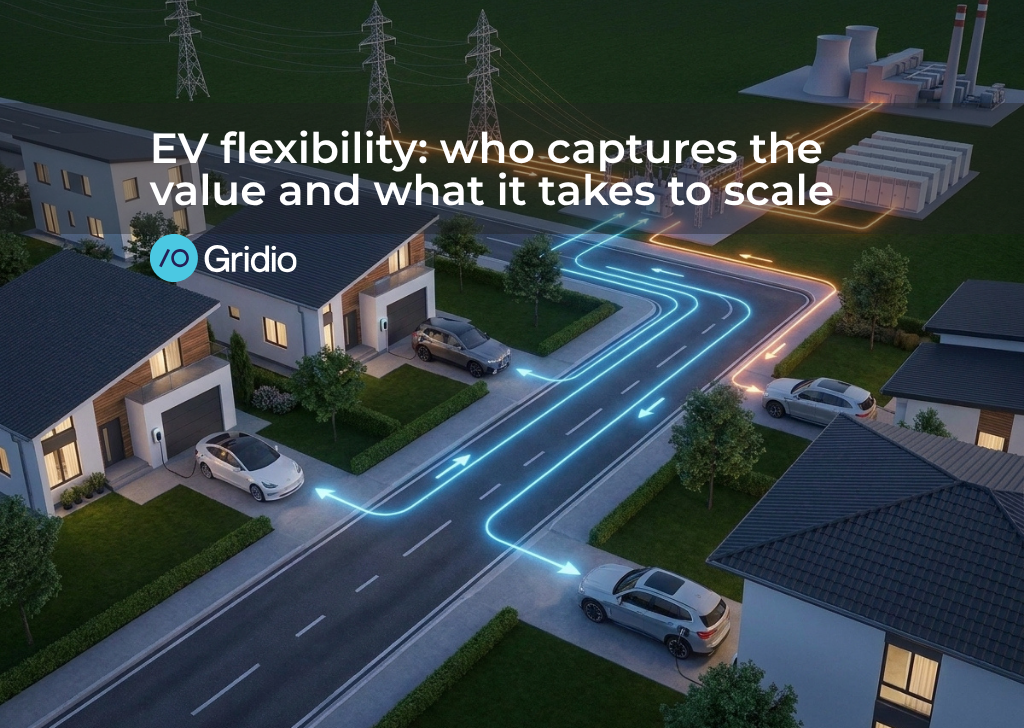
Smart charging and EV flexibility work technically today. Whether they scale now depends on three things: enough cars at a low cost per car, offers drivers understand, and a service drivers can trust.
For energy suppliers the question is becoming urgent. EV charging is still a small part of a supplier's peak demand, but EV sales are growing fast and an EV household uses close to twice the electricity of other homes. A supplier without a smart charging offer risks losing the whole household contract to a competitor that has one, before any trading revenue comes into it. That revenue adds up too: each smart-charged car brings the supplier €100-200 a year.
No single company can deliver EV flexibility alone. The carmaker, the smart charging layer and the energy supplier each hold one part of it, and the driver has to come out ahead.
The technology works and the volume per car is the barrier
Carmaker APIs have improved a lot in the last 1 to 2 years in data quality, latency and reliable charge control. Smart charging no longer needs extra hardware at home: pairing a BMW with a third-party service takes about two minutes. Older cars got backend control after they were built, so model years still behave differently. Native support in new car generations is making control more reliable. Bidirectional charging for vehicle-to-home and vehicle-to-grid has started on the newest models and is expected to become as standard as one-way smart charging.
The economics are behind the technology. When the Baltic states disconnected from the Russian grid in early 2025, balancing became urgent overnight, and grid-scale batteries filled the gap first. Home charging can deliver the same power with far more assets to manage.
Each of those cars belongs to a driver with their own routine, and each car brand and charger works differently. Every brand means another integration and more customer support, while the revenue per car stays small. A utility cannot carry that cost alone. The way through is open access from carmakers: directly for partners with large fleets, and through aggregators that already connect many brands for everyone else.
The market is growing from a real base. EVs already supply most of the residential flexibility traded in Europe, split roughly evenly between supplier-led offers and independent aggregators. The number of home chargers will grow fast over the next decade.
The value has to reach the driver in a simple form
Drivers care about lower charging costs much more than about flexibility. Charging off-peak saves a driver 30-40% of the energy cost compared with charging at peak times, or €100-300 a year for a typical driver. That saving is what has to be sold. Gridio shared its rule of thumb for splitting the value of one smart-charged EV:
Below that share, many drivers would rather set a charging schedule in the car themselves. Flexibility revenue changes from month to month, so it works best passed on as a stable discount or tariff, with the supplier keeping the trading upside. LCP Delta's research points the same way: drivers want a predictable benefit.
Today's offers make this hard. One pays a monthly revenue share, another gives a tariff discount, a third asks for long plug-in hours for vehicle-to-grid. Drivers cannot compare them, so many do nothing. Those with rooftop solar find it hardest to pick the right tariff. Three things make an offer simple:
- One package for the home. Smart charging sold together with solar inverters and home batteries, with one clear benefit such as a discount on the normal rate.
- Onboarding inside the supplier's app. An EV button where the driver connects the car, sees its consumption like a sub-meter and sets when it needs to be ready.
- Set and forget. Drivers want to set things up once and then just plug in. They should never need to learn how the electricity market works.
Reliability and open communication decide whether drivers stay
A driver who finds the car half full before a long drive will not trust the service again. Utilities with years of smart charging behind them have learned this the hard way. The target is a service that works 99.9% of the time. The main gap today is data: fresh, correct state of charge data is still hard to get from every carmaker.
When something does go wrong, honesty helps more than expected. LCP Delta's focus groups found drivers are surprisingly willing to hand over control of their car, as long as they are told openly what happened. The best practice is to tell the driver in the evening that the car will not smart charge tonight, and why. Carmakers now help here by sending maintenance warnings to their partners, who can pass them straight to the driver.
Conclusions from the webinar Roadblocks to flexibility: how collaboration unlocks the value of EV flexibility, hosted by LCP Delta and Gridio on 21 October 2026. Speakers: Lucinda Murley and Laurence Robinson (LCP Delta), Konrad Hanschmidt (Gridio), Sascha Brinkmann (BMW) and Robert Järviste (Enefit). Watch the recording.
