
Home charging can be up to 3x cheaper than public fast charging, but only if you charge at the right time. Smart charging automates this for you.
.png)
Understanding the Cost Components
Before comparing home vs. public, it helps to break down the cost structure:
- Energy cost (€/kWh): what you pay for the generated and consumed electricity itself
- Network & grid fees: infrastructure costs, transmission, distribution
- Taxes, levies & subsidies: vary greatly by country
- Charging operator markup or session fees: especially for public stations
- Charging efficiency & losses: faster chargers or less-efficient charge slows contain losses
Because these vary so much across regions and providers, the difference between home and public charging can be significant.
Home Charging: What Does It Cost in Europe?
For many EV owners, home charging is the default – overnight, while parked, when you're not in a hurry. The cost depends largely on your electricity tariff and what time you charge (peak vs off-peak).
European data & typical rates
- As of early 2025, household electricity prices across Europe have risen and become more volatile, especially in markets that have switched to 15-minute dynamic pricing (e.g., Finland, Sweden, Denmark, Netherlands).
- The average household electricity price in the EU, including all taxes & levies, was about €0.25-0.30 per kWh at the start of 2025.
- Excluding taxes and levies, the energy + network portion averaged about €0.20 per kWh.
- Residential prices vary widely. For instance, as of January 2025, prices ranged from 9 c€/kWh in Budapest to 40 c€/kWh in Berlin.
- In countries using 15-minute spot pricing, price spikes are sharper — short peaks can exceed €0.40–€0.60/kWh even on normal days, while lows can drop below €0/kWh, increasing the savings potential of smart charging.
Example: Home charge cost
Let’s assume an EV with a usable battery capacity of 60 kWh, which provides 300-400km of driving:
- If you charge at a flat rate of €0.22/kWh → 60 × €0.22 = €13.20 per session
- If your dynamic tariff hits off-peak lows around €0.12/kWh → 60 × €0.12 = €7.20 per session
- But if you charge during a price spike of €0.45/kWh → 60 × €0.45 = €27.00
With the shift to 15-minute dynamic pricing, these spikes and dips are becoming more common – meaning your charging cost can swing not just by tens of percent, but by 2–3x within the same day, depending on timing.
Public Charging: The Premium You Pay
Public charging — especially fast DC stations — offers speed and convenience, but often at a premium.
What do European public chargers charge?
- Tesla Superchargers: typically €0.37–0.45/kWh for Tesla owners; €0.52–0.69/kWh for non‑Tesla users.
- Some fast-charging networks (Ionity, for example) have been known to charge €0.79-0.89/kWh for drivers without a contract.
- Public charging prices in Europe fall in the range of €0.35–0.90 per kWh, depending on location, speed, provider, and whether you have a subscription.
Example: Public charge cost
Using the same 60 kWh battery:
- At €0.40/kWh → 60 × 0.40 = €24 per session
- At €0.75/kWh → 60 × €0.75 = €45 per session
That’s roughly 2–3× more expensive than a well-timed home charge.
Home vs Public Charging
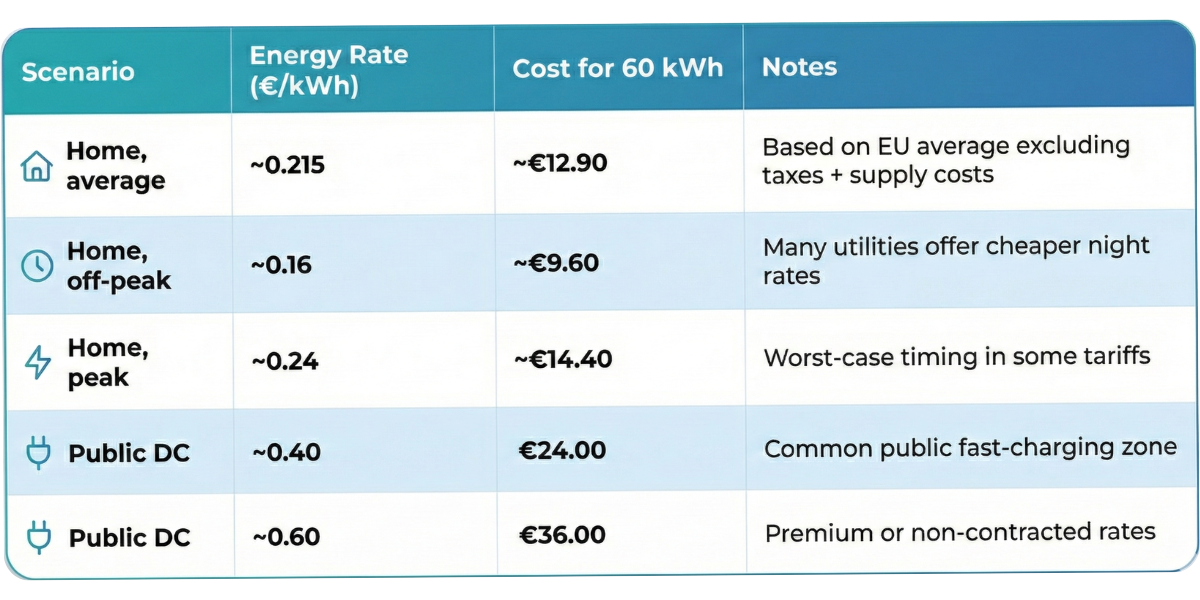
Public charging tends to cost 2–3x more than home charging, especially when your home charging is timed well.
How Smart Charging With Gridio Levels the Field
Here’s where Gridio changes the game:
- Timing control: Gridio ensures your EV only charges during the lowest-cost windows (off-peak, low-demand/high zero-carbon supply hours).
- Cleaner energy: Off-peak often coincides with periods of surplus renewable generation (wind, solar), so your charging is greener.
- Cost savings: Many users see up to 50% reduction in their EV electricity costs compared to naive charging.
- Seamless & universal: No need to monitor prices manually — the app handles it. Works across brands, chargers, and energy suppliers.
So while public charging is still useful for trips or emergencies, Gridio aims to make your everyday charging at home as cheap as it gets.
Real-World Scenarios & Recommendations
Scenario A: Daily commuting
If you drive ~40–60 km daily and charge mostly at home:
- You’ll primarily incur home electricity costs
- Use Gridio to ensure charging during off-peak windows
- Expect 30–50% savings compared to manual overnight charging
Scenario B: Mixed – Home + Occasional public
- Use home + Gridio for nightly top-ups
- Use public DC only on long trips or when you need fast top-ups
- The average cost per kWh remains low, because public charging is just a small fraction of your usage
Scenario C: Long trip, heavy reliance on public
- Costs will be dominated by public DC pricing
- Plan route to include lower-cost stations
- Use charging network subscriptions to reduce per-kWh markup
Real Gridio Savings Across Europe
Smart charging isn’t just theoretical, the savings are real. Based on thousands of charging sessions across Europe, Gridio users achieve:
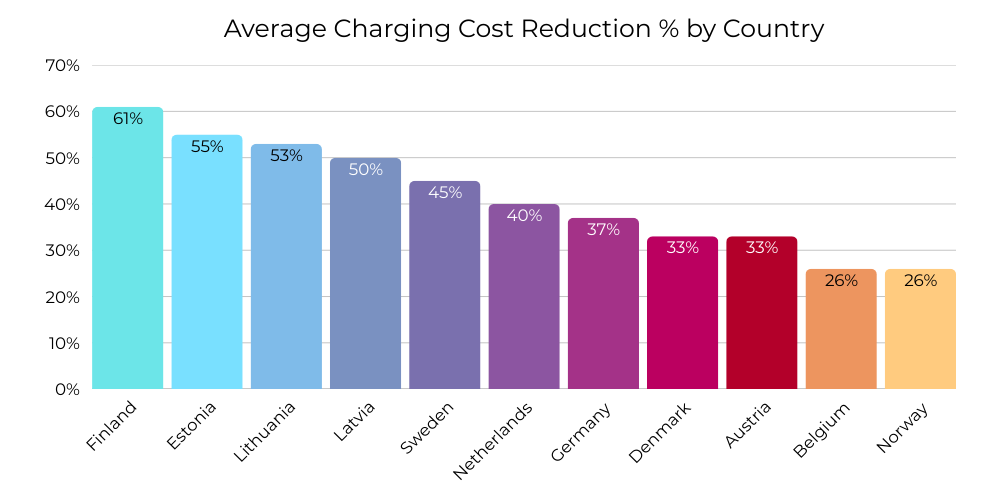
Across all markets, Gridio users typically save €100–€250 per year simply by letting the app charge their EV during the cheapest hours with no hardware required.
Key Takeaways
- Home charging is almost always cheaper than public charging – especially when timed well.
- Public DC chargers are convenient but come with a premium, often 2–3x what home charging costs.
- The difference stems from operator markups, infrastructure costs and slower or less flexible pricing.
- Smart charging tools like Gridio can capture the lowest possible rates by charging only during optimal hours.
- For everyday use, home + smart charging is the ideal strategy. Public is your backup or for travel.
Gridio is Europe’s #1 official smart charging app, trusted by major car brands. Your EV automatically charges when electricity is cheapest and cleanest and you don’t need any additional equipment – just the Gridio app. The setup will take 5 minutes!
📲 Download on the App Store or Google Play and start saving today.

