
Winter EV charging in the Nordics can cost 30–70% more than summer, but not because of the cold itself. The real problem? Summer charging habits stop working when Nord Pool prices turn volatile. This guide explains why winter transforms EV charging economics and shows the practical steps that actually cut costs.
.png)
Why Winter Transforms EV Charging Economics
Winter creates a perfect storm that hits EV charging costs from multiple angles:
Grid stress from heating demand: When temperatures drop below -10°C, electricity demand surges by 20–40%. Homes, offices, and industry all consume more power simultaneously.
The dark, calm period problem: Nordic winters mean less solar and periods of low wind. When high pressure systems settle over Scandinavia, wind turbines slow down just as demand peaks. In these periods, fossil fuel plants fire up, and electricity prices can spike to €0.50–€1.20/kWh in 15-minute intervals.
15-minute pricing volatility: Since many Nordic and Baltic markets moved to 15-minute settlement periods, price volatility has roughly doubled in winter. A cold snap with low wind can create price spikes lasting just 30–90 minutes but costing €15–€25 extra on a single charge.
Battery physics works against you: Lithium-ion batteries lose 20–40% efficiency below 0°C. Your battery must heat itself before and during charging, overcome increased internal resistance, and compensate for reduced chemical reaction speeds. Result? You're paying for 45–50 kWh to get 35 kWh of usable charge.
Winter driving conditions drain batteries faster: Cold air has higher density, increasing aerodynamic drag. Winter tires have more rolling resistance than summer tires. Snowy roads require more energy for traction. Combined, these factors can reduce your real-world range by another 15–25% beyond the battery efficiency losses. This means you'll need to charge more frequently – making smart, cost-effective charging even more critical.
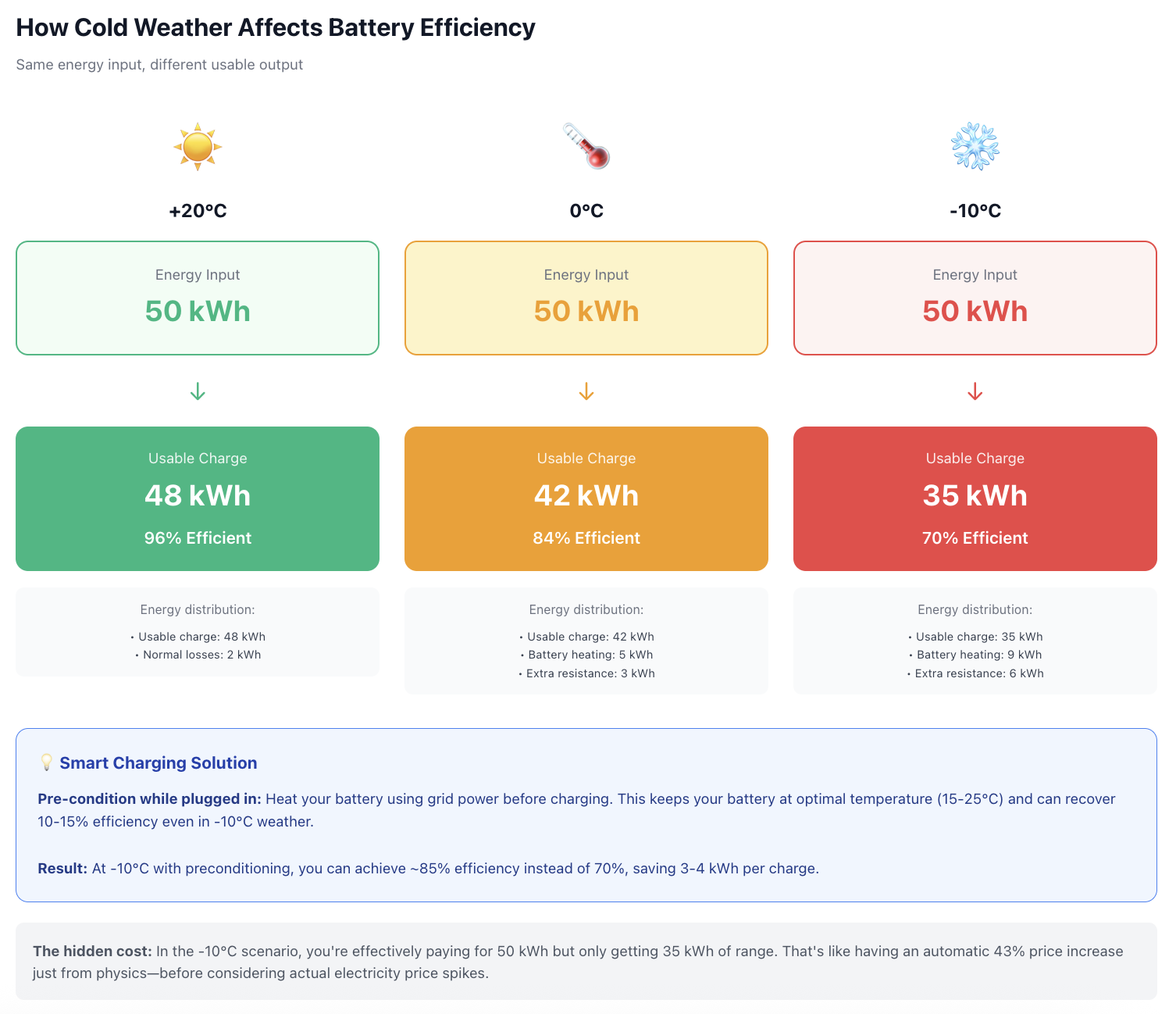
The Real Numbers: What Winter Actually Costs
Let's use a real example from January 2025 in the Nordics
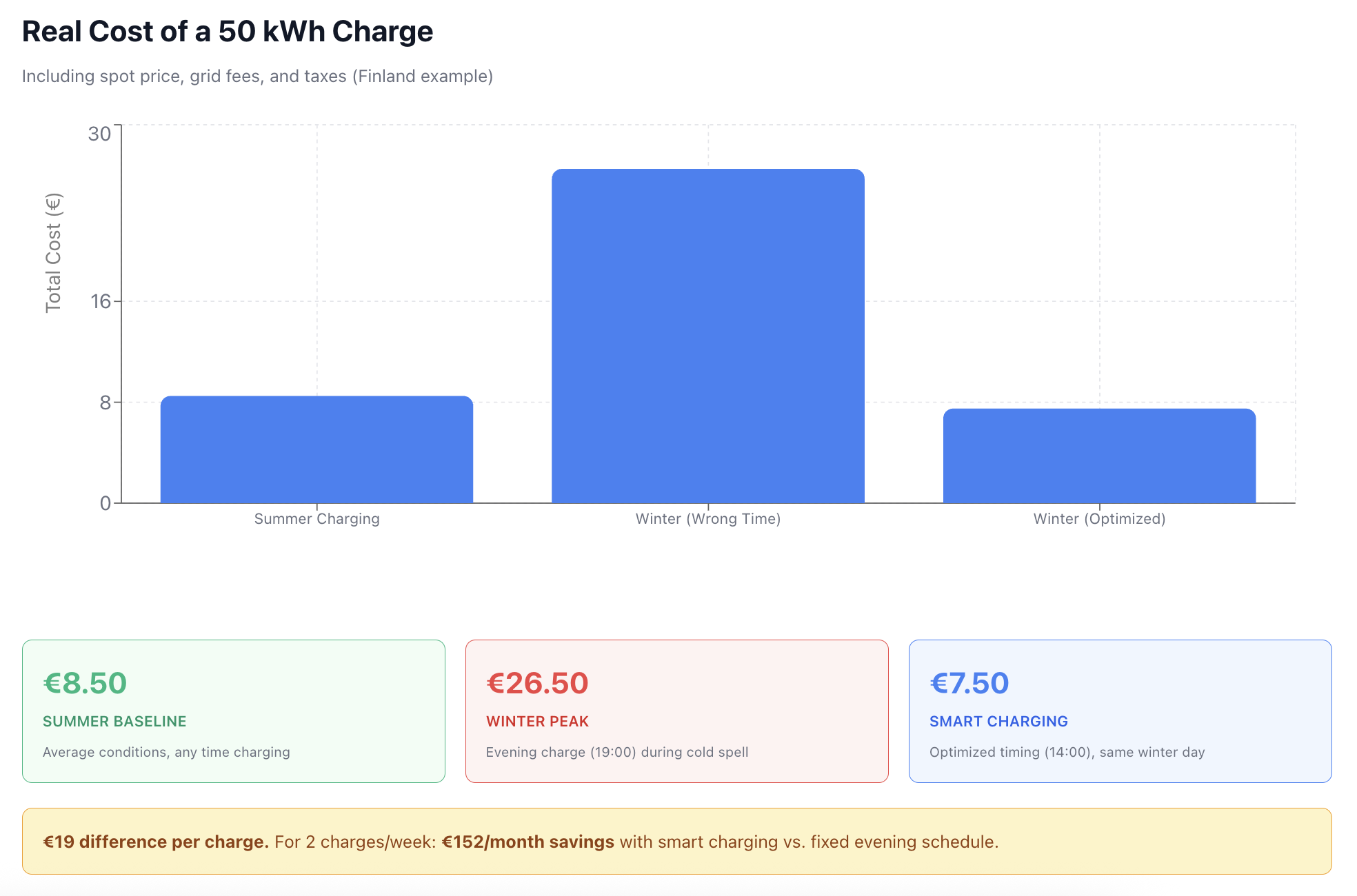
Why "Charge at Night" Is Outdated Advice
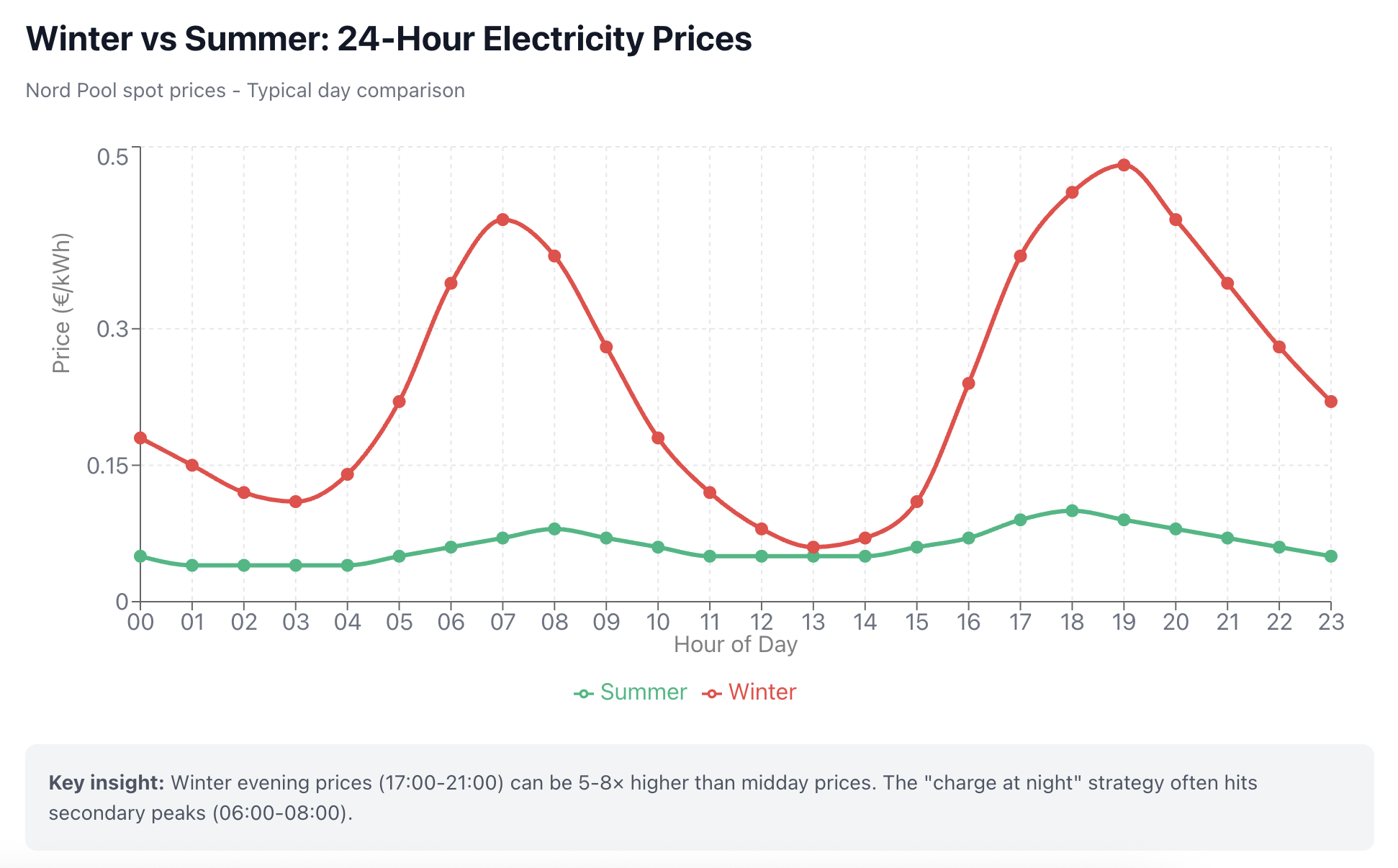
For years, everyone said: "Just plug in at 23:00 and charge overnight." In 2026, this strategy fails routinely:
The night price trap: During prolonged cold spells, night prices can be higher than midday prices when industrial demand drops and wind picks up. We've seen 02:00–05:00 periods at €0.28/kWh while 12:00–14:00 was €0.06/kWh.
Fixed timers can't adapt to this volatility. You need dynamic optimization.
Advanced Winter Charging Strategies
Strategy 1: Master Battery Preconditioning
Most modern EVs have battery preconditioning. Set your departure time so your car heats the battery using grid power, not battery power. This saves 3–5 kWh per charge. Pro tip: Precondition when prices are lowest, not just before you leave.
Strategy 2: The 80% Winter Rule
Batteries charge fastest from 20–80%. In winter, charging 80–100% takes 2–3× longer, often spanning into peak hours. Charge to 80% daily and save 100% charges for long trips planned during off-peak periods.
Strategy 3: Use Workplace Charging Strategically
If your workplace offers charging, minimize home charging during expensive evening peaks and top up during cheaper midday hours. Even paying €0.15/kWh at work beats evening spot prices at €0.35/kWh.
Strategy 4: The "Split Charge" Method
Instead of one 50 kWh charge, do two 25 kWh charges to catch multiple price valleys—for example, 13:00–15:00 and again 02:00–04:00 if night prices drop.
Winter-Specific Myths Busted
❌ Myth 1: "Fast charging is always more expensive"
✅ Reality: DC fast charging during a midday price valley can be cheaper than home AC charging during an evening spike. Check prices, not charging speed.
❌ Myth 2: "Cold weather ruins EV batteries"
✅ Reality: Cold temporarily reduces capacity but doesn't damage batteries. Regular charging to 100% in cold weather causes more degradation than the cold itself.
❌ Myth 3: "Always charge to 100% in winter for range"
✅ Reality: You lose less range from cold than you gain from efficient charging timing. Better to charge to 80% at €0.05/kWh twice than 100% at €0.30/kWh once.
❌ Myth 4: "Cabin pre-heating wastes energy"
✅ Reality: Pre-heating with grid power while plugged in uses 1–2 kWh but saves 5–8 kWh during the drive.
❌ Myth 5: "Smart charging means my car won't be ready when I need it"
✅ Reality: Modern smart charging apps guarantee your car is fully charged by your departure time – they just optimize when charging happens.
The Checklist: Immediate Actions
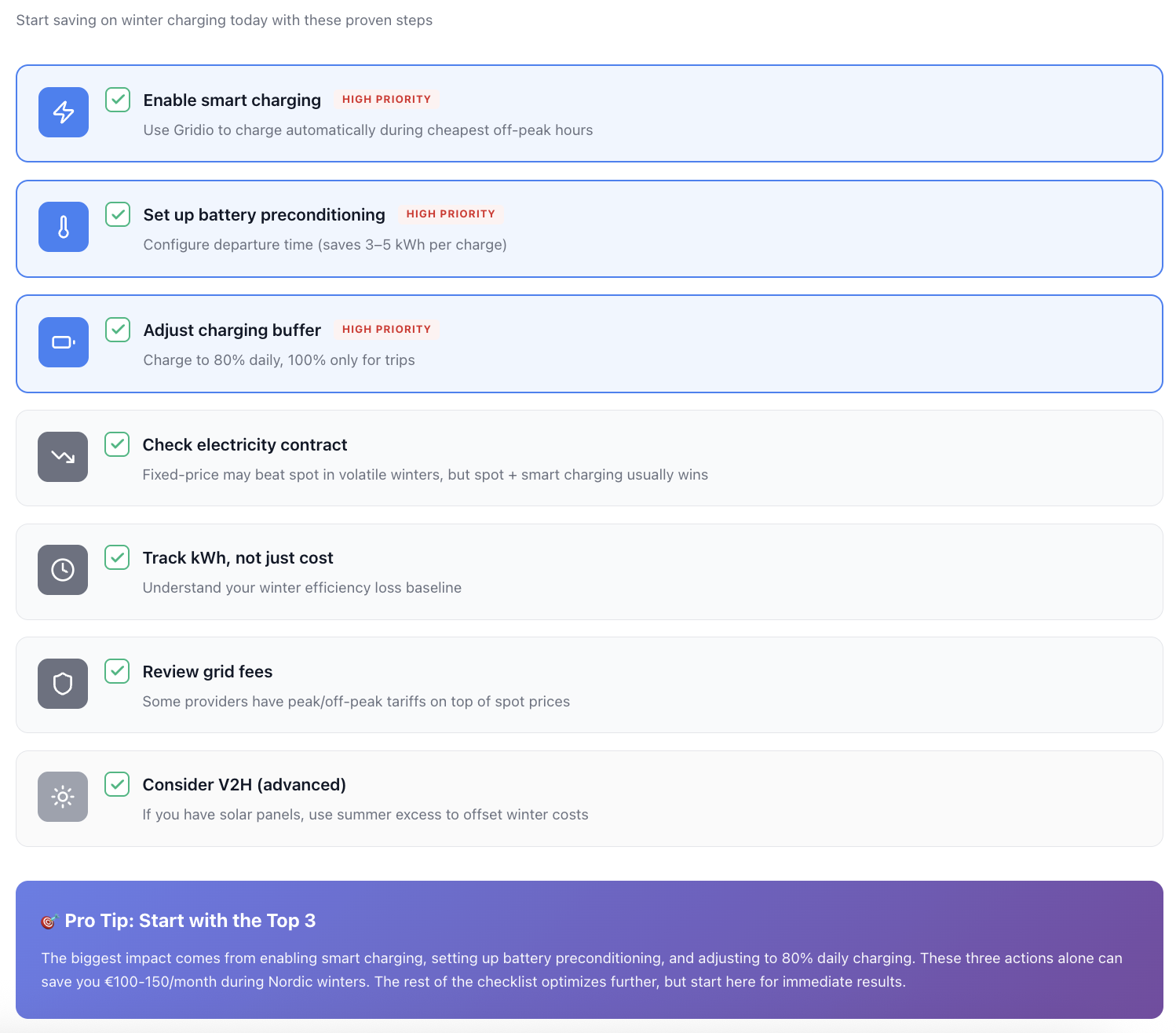
The Bottom Line
Winter doesn't have to mean higher EV charging bills. The difference between expensive and cheap winter charging isn't luck or complicated routines – it's having a system that automatically responds to the conditions that change every hour.
In 2026, Nord Pool markets see 10–20× price differences within the same day and price patterns that change with weather and grid conditions. Manual scheduling can't keep up.
Smart charging turns winter from a cost problem into an opportunity. While others see bills spike, you're charging for less than summer – automatically, without thinking about it.
📲 Download Gridio and let your EV handle winter charging intelligently. Your wallet (and the grid) will thank you.

